
The Pronghorn Xing project is a collaborative initiative aimed at enhancing ecological connectivity across the Northern Sagebrush Steppe (NSS) in Alberta and Saskatchewan to both conserve pronghorn and other grassland species and deliver regional wildlife conservation and public safety.
Grasslands are among Canada’s most threatened ecosystems due to conversion to agriculture, residential, and industrial development. Grassland species, such as pronghorn, are particularly affected by barriers such as highways, railways, and fences.
Did you know?
Different species have different preferences and requirements for crossing structures.
Pronghorn prefer overpasses while mule deer, for example, prefer underpasses.
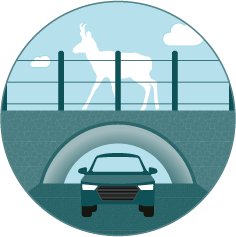
Pronghorn are known to prefer using overpasses.
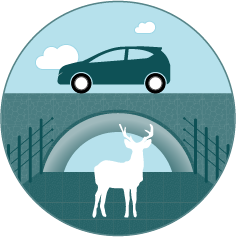
Other animals such as mule deer prefer using underpasses.
Pronghorn are native to North America's grasslands and are known for their complex and adaptive migrations. However, human-made barriers such as fences and roads have disrupted these natural movements, limiting access to essential habitats and resources. Studies have shown that pronghorn encounter fences on-average 244 times a year, with a portion of these interactions leading to a change in direction, or worse, becoming trapped. In addition to fences, Pronghorn avoid high-traffic roads such as the Trans-Canada Highway (TCH) where they risk getting hit. Highway avoidance further impedes their ability to connect to habitats vital to their conservation.
Pronghorn Xing aims to inform decisions around addressing linear infrastructure barriers with a focus on roads and fences. Studies elsewhere (e.g., Banff, Wyoming, California) indicate that risks to motorists and wildlife on highways can be effectively mitigated with the installation of road mitigation, such as crossing structures and fencing.
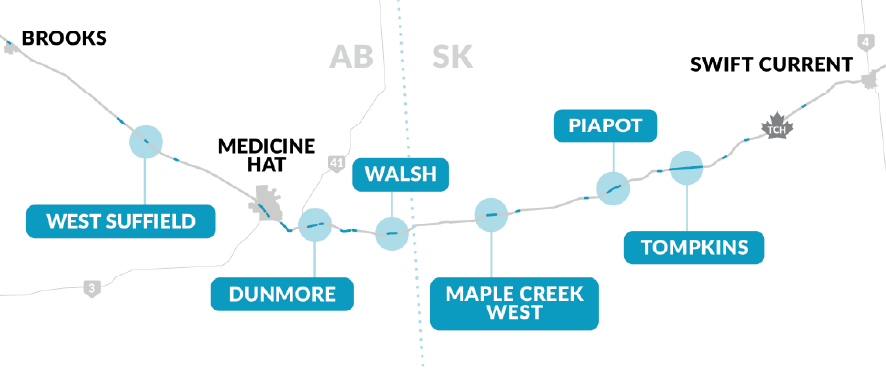
Motorist and wildlife safety in the sagebrush steppe ecosystem between Brooks, Alberta and Swift Current, Saskatchewan can be improved with wildlife crossing structures. Through rigorous scientific assessment (detailed on the About page), the Pronghorn Xing team has prioritized six locations where road mitigation will conserve grassland species and deliver regional wildlife conservation and public safety, as part of a broader road mitigation system.
As of October 2024, Pronghorn Xing is in the engagement and outreach phase of the project where we will connect with key audiences to promote implementation of a road mitigation system. Pronghorn Xing is following the outcomes of two new studies; Pronghorn Winter Survival and Migration (website coming shortly) and Alberta Mule Deer Collaring Project (www.albertacollaringproject.com).
Project Partners



Project Funders
This project was undertaken with the financial support of the Government of Canada through the federal Department of Environment and Climate Change. Ce projet a été réalisé avec l'appui financier du gouvernement du Canada agissant par l'entremise du ministère fédéral de l'Environnement et du Changement climatique.
National Fish and Wildlife Foundation
with support from the Bezos Earth Fund, Burger King, Capri Holdings, and Cargill
Project Collaborators
- Alberta Environment and Protected Areas
- Alberta Ministry of Forestry and Parks
- Alberta Transportation and Economic Corridors
- Dialogue
- Nature Conservancy of Canada
- Saskatchewan Government Insurance
- Saskatchewan Ministry of Environment
- Saskatchewan Ministry of Highways